
Learn how a simple conversation set the stage for something transformative.
Learn how a simple conversation set the stage for something transformative.

The non-profit museum, which has existed for over 200 years, has always been a steward of the past but was searching for new ways to bring history to life. The IHS honored our founder, Ben Lytle, in 2023 for his achievements and contributions to the great state of Indiana, which led to a pivotal conversation with IHS CEO, Jody Blankenship.
“What immediately excited me about AlterEgoTM was its ability to turn history into a lived experience rather than a static one. This wasn’t about novelty—it was about authenticity, rigor, and respect for the people and stories we steward. ARK understood that from day one, and their commitment to historical accuracy and ethical use of AI made it clear we were working with a partnerwho shared our values.”
– Jody Blankenship | IHS | CEO
Blankenship had a vision: the belief that artificial intelligence, far from being a disruptor of history, could be its greatest ally. He wasn’t alone in thinking this way. Lytle’s company, ARK, had developed AlterEgoTM, an AI-powered virtual assistant capable of doing far more than just answering routine questions. For Blankenship, this technology offered a new way for IHS visitors to experience the past.
By early 2025, the IHS and ARK had partnered and, with full funding secured via an endowment, our work began in earnest. The goal was clear: The IHS needed to reimagine its exhibits to immerse its visitors in the history they came to see.
The IHS has a veritable treasure trove of books, letters, audio recordings, and videos in its collection, but these materials weren’t being used to their full potential, as exhibits relied on traditional media. The IHS wanted to try a dramatically different approach that would not only make it easier for members of the public to access its full collection but would also spark curiosity and enable them to engage with history on a personal level.
After a series of conversations with IHS staff, we proposed a new concept:
Historical Figures.
By combining the museum’s existing materials, including archival recordings, with live footage of real actors in period-accurate costumes and AlterEgoTM generative AI video technology, we could create digital versions of famous Hoosiers that could interact with visitors in real-time. Compared to traditional exhibits, these avatars could answer questions, tell stories, and provide deeper insights into the lives of the figures they represent.
But it wasn’t a simple task. It took time to narrow down which Hoosiers to feature — the IHS settled on two, Madam C.J. Walker and Gus Grisom — and required combing through archival materials to ensure we had enough content to base each Historical Figure on. There were also permissions to secure, technical specifications to define, and ethical guidelines to follow, with help from an AI ethicist.
The design process then began. Every detail, from the visual design to how the avatars move, was carefully considered to ensure each one felt like a real person rather than just a digital representation. We also used 4K footage quality to create sharp, high-resolution video that would last for years to come.
As the Historical Figures began to take shape, we faced the delicate task of ensuring the avatars were as accurate and authentic as possible. Live actors dressed in period-appropriate costumes helped bring the figures on screen and,
with help from IHS staff, we built a foundational knowledge base for each avatar from biographies, autobiographies, letters, journals, recordings, and other archival materials. One Historical Figure — that of Madam C.J. Walker — even features the voice of her great granddaughter, directly tying the past to the present.
The AI itself is where the real innovation lies. Powered by AlterEgo™, the Historical Figures are able to listen, respond, and adapt to visitors’ questions, offering personalized, historically grounded answers in real time.
Using advanced speech-to-text, text-to-speech, bounded LLMs, and perception models, the Historical Figures can understand and speak with visitors for an interactive, immersive experience that’s as close as possible to conversing with these actual individuals themselves.
By fall 2025, the Historical Figures project was ready for its first unveiling to internal user groups, followed by a presentation to board members in January 2026. ARK had moved faster than anyone anticipated, and the results speak for themselves.
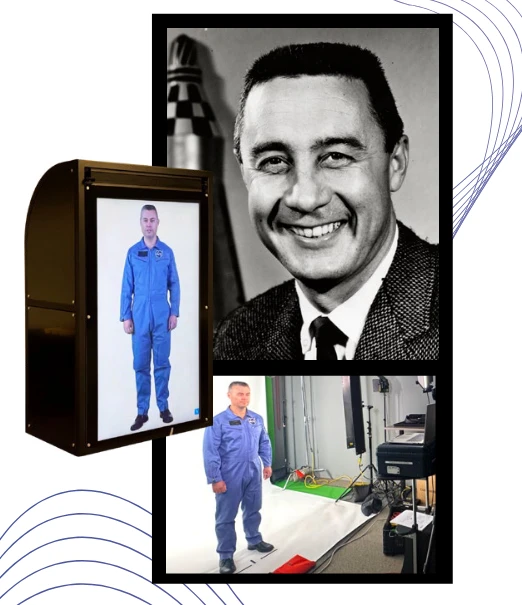
When visitors approach an exhibit, it triggers a motion sensor, and the Historical Figure “wakes” up, seemingly coming to life with subtle shifts in posture and facial expression. Visitors can ask the Historical Figure questions, which they respond to in real-time, creating interactions that feel both personal and genuine. When asked questions that fall outside their defined scope, such as those about current events, each figure’s built-in guardrails enable them to provide varied responses that subtly steer the conversation back to something that occurred within their lifetime.
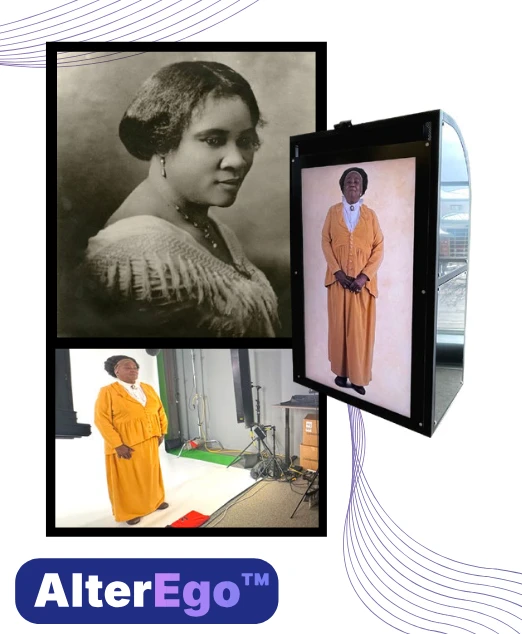
AlterEgo™ can also communicate in up to 34 languages, making the experience accessible to visitors from all over the world. This scalability isn’t limited to in-person exhibits, either. With the technology in place, the IHS can take this experience online or even into classrooms to give students a living window into the past. Thanks to AI, the IHS is able to run multiple instances of each Historical Figure at once, so they can engage with multiple visitors simultaneously. The IHS and members of ARK continue to work together to continuously refine each figure, incorporating new feedback and insight as it’s received, thereby creating an experience that will stand the test of time.
Now that the IHS has rolled out the Historical Figures, they’re already having a ripple effect. The museum has secured funding to add two more figures and to expand its work with ARK with a new AI-powered Docent app that can lead tours in over 30 languages. Our partnership with the IHS has
transformed the museum’s exhibits, set new standards for how technology can bring history to life, and offer a glimpse into the future of museums themselves — and the future is bright.