How AI helps museum staff prioritize what’s important
How AI helps museum staff prioritize what’s important

When the Indiana Historical Society (IHS) partnered with ARK to bring its Historical Figures to life, it marked the beginning of a deeper conversation about what AI could do for the museum — both its visitors and the people who make it run.
Behind all of IHS’s exhibits and public-facing programs is a team of dedicated reference librarians who work to connect members, visitors, and researchers to the museum’s vast archival collections. It’s meaningful work, but far too much of their time was consumed by tasks that had little to do with actually helping people. Instead, their days were shaped by routine phone calls, manual scheduling, and administrative follow-up that pulled them away from the hands-on research support that defines their role.
The IHS relied on a traditional phone tree, with welcome desk personnel on standby to field incoming calls, many of which were basic information requests that could take up a significant portion of an operator’s day. Any calls that came in after hours went straight to voicemail, leaving staff to work through a growing backlog every morning before they could turn their attention to anything else.
Scheduling added another layer of complexity. IHS managed its reference room appointments through a shared Excel spreadsheet, with staff manually blocking out times and tracking requests by hand. The stakes were higher than they might appear: Many of the museum’s archival materials are kept in cold storage to preserve their integrity. Before a researcher can handle them, those items need to be pulled and allowed to acclimate to room temperature, a process that can take several hours. Under these conditions, a scheduling error could result in a mistimed appointment or worse, the mishandling of irreplaceable materials.
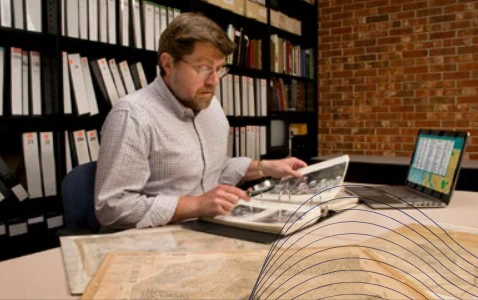
The reference team also manages the IHS’s reproduction services from end to end, fielding requests for high-resolution image files, photocopies, and scans; verifying whether the museum can fulfill each one; communicating pricing; capturing payment information and contact details; and coordinating delivery, typically via email.
Each request required multiple back-and-forth exchanges, and the cumulative weight took a toll.
In tandem with the Historical Figures project, the ARK team worked closely with IHS’s reference librarians to map their existing workflows and identify where AI-powered automation could make a meaningful difference. From these conversations, the Library Assistant was born.
“ARK’s AlterEgo™ stood out because it addressed real, everyday challenges for our staff while opening entirely new possibilities for public engagement. ARK took the time to understand how we work — from cold storage requirements to reference workflows — and then built a solution that fit us, not the other way around. That combination of technical sophistication and deep listening is what convinced me we were working with the right team.”
– Jody Blankenship | IHS | CEO
The Library Assistant is powered by a bounded large language model (LLM), one whose behavior is constrained by rules and orchestration logic to operate within a carefully defined scope. We trained this model on IHS’s collection guides, cold-storage protocols and lead times, pricing information, and donation policies, then connected it to the museum’s existing systems.
Crucially, that included the same Excel spreadsheet the reference team already used for scheduling. Rather than ask staff to change the way they worked, we built the Library Assistant to work around them, meeting them where they are while still driving meaningful efficiency.
To give IHS an elevated, round-the-clock caller experience, we integrated the Library Assistant directly with the museum’s phone system. This integration works entirely behind the scenes: All calls are routed through ARK’s system before being connected, with no change to the museum’s existing phone system and no perceptible difference to callers. From there, the Library Assistant uses speech-to-text to recognize what callers are asking and text-to-speech to respond naturally, holding real conversations, understanding context, and resolving routine requests on the spot. Calls that require live assistance are redirected to staff accordingly.
“Smaller tasks like scheduling appointments, answering introductory reference and research questions, and manually taking scan orders are all important to the function of our library, but their time can add up. By automating these tasks with ARK, library staff can dedicate more of their time to in-depth projects.”
– Regan Steimel-Alveal | IHS | AI Project Coordinator
Accessible by phone at any hour of the day, the Library Assistant now functions as a highly knowledgeable front-line staff member, one that never clocks out. Callers can ask natural questions and receive accurate, context-rich answers as though they are speaking directly with an experienced librarian.
Beyond answering questions about IHS’s collections, the Library Assistant can schedule reference room appointments, automatically accounting for cold-storage lead times so materials are ready when researchers arrive. It also fields reproduction requests from start to finish, turning what used to be a multi-step, staff-dependent process into a single phone interaction. The Library Assistant can even distinguish between callers looking to make financial donations and those hoping to contribute physical items, gently steering conversations toward monetary gifts while providing information on the museum’s object donation policies.
Last, though certainly not least, the Library Assistant supports donor outreach, including notifying members of new exhibits and upcoming events, extending the IHS’s reach without adding to anyone’s plate.
The results of this project speak for themselves. The Library Assistant now supports access to 100% of the museum’s collections, dramatically increasing access to its archive. Afterhours calls that once went unanswered until the following morning can now be fully resolved in real time, providing 24/7 coverage and significantly reducing the backlog staff face at the start of each day. And, by handling the most repetitive aspects of the reference team’s workload, the Library Assistant gives IHS’s librarians the time and bandwidth to do what they do best: provide the nuanced, in-person research support that no AI can replicate.
And that’s the most important part. IHS’s goal was never to replace the people who make the museum a warm, welcoming environment where the past and present come together and Hoosiers can learn about their great state, but to help them thrive.
“The success of this project is measured not just in efficiency gains, but in people — our staff, who feel supported rather than stretched, and our members, who can now connect with our collections in new and meaningful ways. That’s the kind of progress that truly matters to us.”
– Jody Blankenship | IHS | CEO
Currently available as a phone- and email-based service, the museum plans to expand the Library Assistant to its website in the future. For IHS, this represents something that’s become a throughline in its partnership with ARK: technology that meets people where they are, enhances what they already do well, and reimagines storytelling.
“We are focused on dramatically expanding who can engage with Indiana’s history and how they do it. That means breaking down barriers, whether they’re physical, technical, or time-based, and meeting people where they are. By making our collections more interactive and responsive, we’re ensuring that history is accessible,
relevant, and meaningful to a much broader audience.”
– Jody Blankenship | IHS | CEO